The most useful question a cafe or brand can ask before ordering custom coffee sleeves is not what they should look like but how many sizes they need to buy. It feels like every cup size should want its own sleeve, so people brace for a complicated matrix of SKUs. The reality is far simpler, and it comes down to one measurement that most cup charts bury: the rim diameter.
The number that decides fit is the rim, not the volume
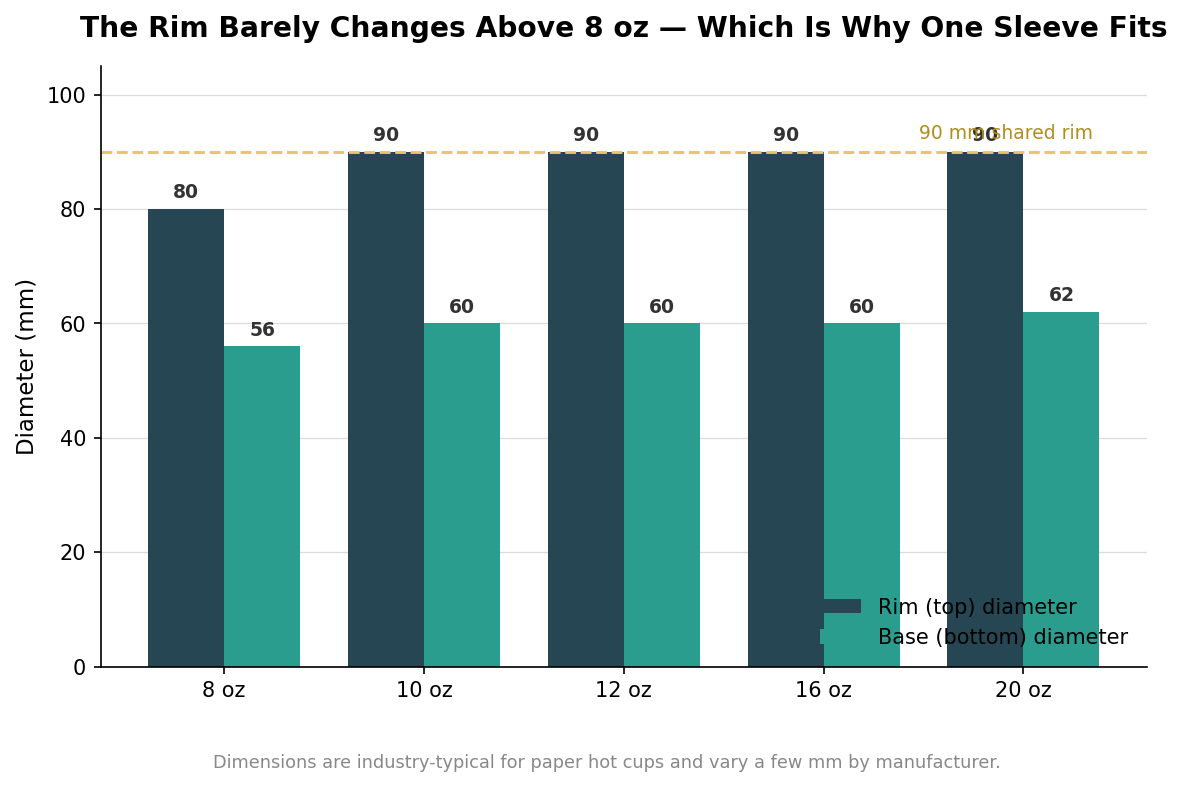
A cup’s advertised size is a volume, but a sleeve does not grip volume. It grips the outside of the cup wall, near the lower third, and what matters there is diameter. Once you sort hot cups by their top diameter instead of their ounces, the picture collapses into two groups. An 8-ounce cup runs about 80 millimeters across the rim with a 56-millimeter base. Nearly everything above it, from 10 ounces up through 20, shares a rim of about 90 millimeters and a base right around 60 to 62 millimeters. That single 90-millimeter rim is the workhorse of the disposable-cup industry; it is why one plastic lid covers four different capacities, and it is why one sleeve does too.
Why one sleeve covers 12, 16, and 20 ounces
Look at the base and rim numbers for the 12, 16, and 20 ounce cups and they are almost identical: the same 90-millimeter rim, a base within two millimeters of each other. The cups differ in how tall they are, not in how wide. Because a sleeve is a short band that sits low on the cup where the wall diameter is nearly constant across those three sizes, the same standard sleeve slides onto all of them and holds. This is not a loose approximation; it is how the supply chain is designed. A sleeve rated for 12 to 20 ounces, often sold as the standard size with a caliber around 90 millimeters, is doing exactly what the shared cup geometry allows.
The practical consequence is that a shop pouring 12, 16, and 20 ounce drinks does not need three sleeve designs or three inventory lines. One standard sleeve, printed once, covers the entire large-drink range, which also means one artwork setup, one minimum order to hit, and one box to restock.
Where the 8-ounce cup breaks the pattern
The exception is the small cup. An 8-ounce cup is genuinely narrower, roughly 80 millimeters at the rim against the 90 of everything larger, and its base is smaller too. A standard sleeve built for a 90-millimeter cup will sit loose on it and can slide or spin, which is exactly the failure a sleeve is supposed to prevent. If your menu includes 8-ounce short drinks, espresso-forward cortados, or kids’ cocoa, that size needs its own smaller sleeve, typically an 80-millimeter caliber band. Ten-ounce cups, by contrast, already share the 90-millimeter rim, so they ride on the standard sleeve with the rest.
So the honest answer to how many sleeve sizes most operations need is one or two. One standard sleeve if you only serve 10 ounces and up, and a second small sleeve only if 8-ounce cups are actually on the menu.
Height, taper, and where a sleeve actually grips
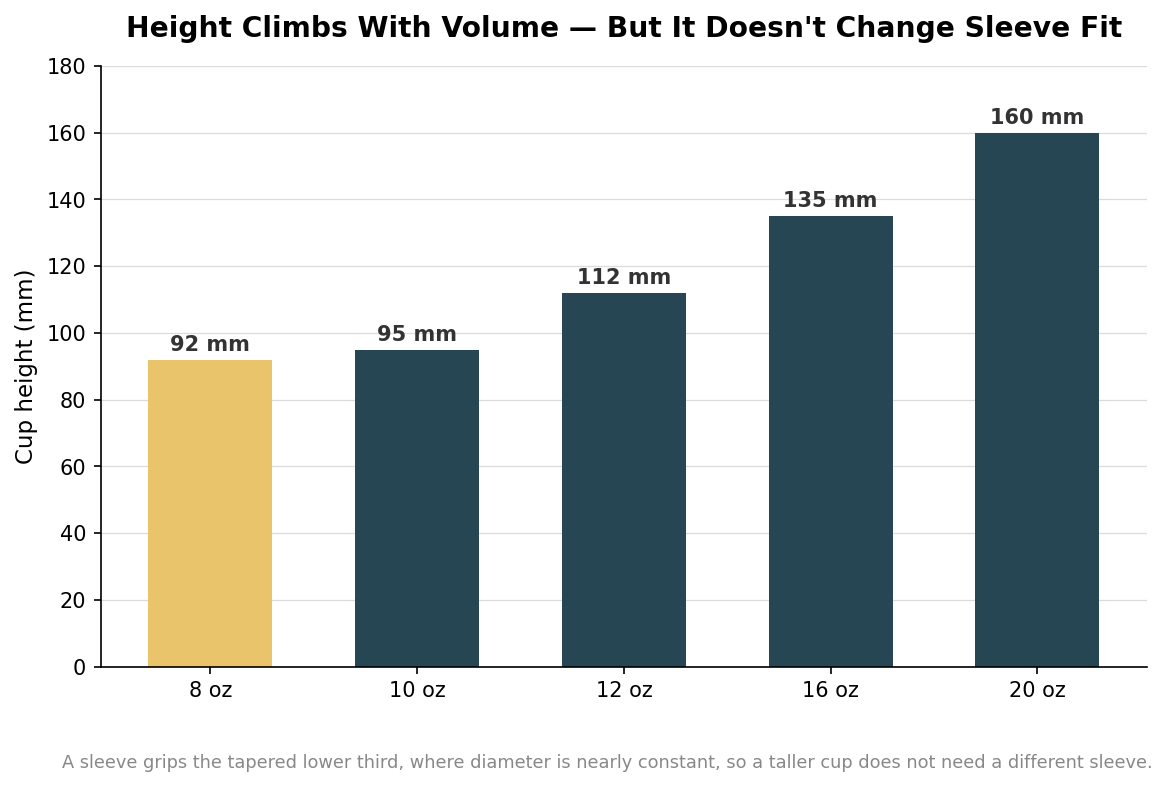
It is worth being clear about why height does not enter the fit calculation, because it is the number that changes most across sizes. A 12-ounce cup stands about 112 millimeters tall, a 16-ounce about 135, and a 20-ounce about 160, yet all three take the same sleeve. The sleeve wraps a band a couple of inches tall around the lower portion of the cup, below the widest point, where the taper has brought the three cups to nearly the same circumference. A taller cup simply leaves more bare wall above the sleeve. That is also why you match a sleeve to a cup by measuring the diameter at the grip zone, not by reading the ounce number or the height off the box.
One category sits outside this whole calculation: double-walled and ripple-wall cups. These build the insulation into the cup itself with a second layer or a corrugated outer skin, so the wall is already comfortable to hold and often needs no sleeve at all. If part of your menu uses double-walled cups and part uses single-wall, size sleeves only for the single-wall cups and treat the insulated ones as their own line. Layering a sleeve over an already double-walled cup is usually paying twice for the same warmth, and it can make the cup too fat to hold well.
What to actually order
Translate this into an order and it gets short. Inventory your cup menu by rim diameter rather than by advertised ounces, and you will almost certainly find your hot cups fall into the 90-millimeter group with at most a single 80-millimeter outlier for a small size. Order the standard sleeve for the 90-millimeter cups and, only if you serve 8-ounce drinks, add the small sleeve for those. Confirm the exact rim and base measurements of the specific cups you buy before committing to a print run, since figures vary a few millimeters between manufacturers and a sleeve that fits one brand’s 12-ounce cup snugly may sit slightly differently on another’s. Get those measurements right once and the sizing question, which looked like it needed a spreadsheet, turns out to need a single standard sleeve and maybe one small companion.
Leave a Reply