A coffee sleeve is a small canvas with a stubborn surface. Most of the disappointment people feel when a custom sleeve arrives comes down to one thing they did not plan for: the way ink actually behaves on the board, at the color count they chose, in the quantity they ordered. None of that is complicated once you see how the pieces fit, and getting it right is the difference between a sleeve that looks intentional and one that looks like a compromise.
Your artwork meets the board, not a screen
The first fork in the road is the substrate. A natural kraft sleeve is brown, and brown is not a neutral background the way white is. Ink laid over kraft mixes visually with the base color, so a bright green comes out noticeably duller and softer than the same green printed on white board. This is not a printing defect; it is how a semi-transparent ink interacts with a colored surface. The practical takeaway is direct: if your brand look is built on a single confident color, kraft with black or white ink looks clean, minimal, and deliberately crafted, and you never have to worry about muddy color. If your design depends on vivid full-color artwork or a photo, specify a white sleeve instead, where the ink can sit on a neutral base and stay vibrant.
Corrugated sleeves add a second wrinkle, literally. The fluted texture that gives a sleeve its grip and insulation also means the printing surface is not perfectly flat. Fine hairlines, small reversed-out type, and heavy solid coverage are less forgiving on a corrugated face than on a smooth flat board, so simple, bold artwork holds up better than intricate detail.
Three ways a sleeve gets printed
Custom sleeves are decorated with the same family of processes used across paper packaging, and the one you land on is usually decided by your quantity more than your taste. Digital printing lays down full CMYK with no printing plates, which means no per-color setup charge and the ability to run small batches, typically in the 500 to 1,000 range. It is the natural home for short runs, event orders, and anyone who wants to test a design before committing. Offset printing steps up image quality, handling CMYK plus spot colors with photographic detail and smooth gradients, and sits in the middle for volume. Flexographic printing uses plates and is built for scale; it reproduces one to six spot colors cleanly and becomes extremely efficient once you are into tens of thousands of pieces, which is why its minimum orders start high.
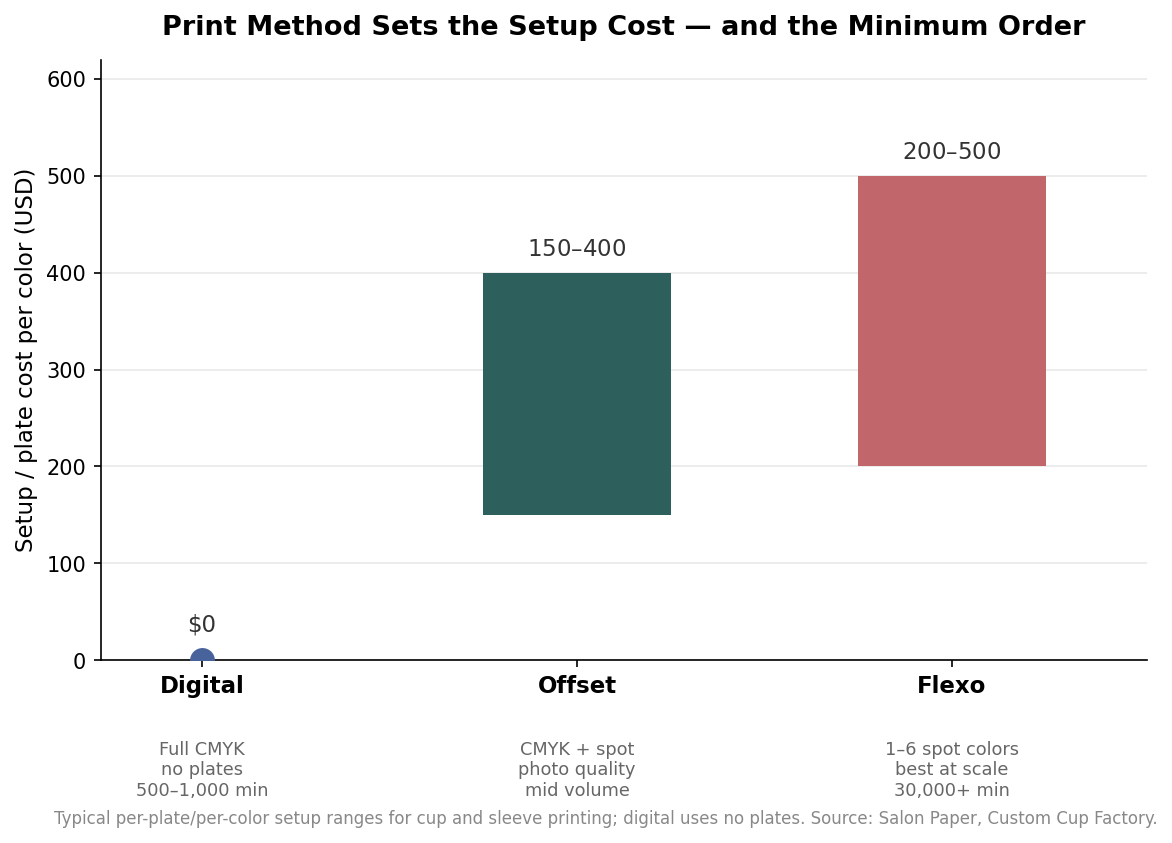
The reason to understand the three is that they are not interchangeable at every size. Asking a flexo line for 800 sleeves makes no sense, and asking a digital press for a photo-perfect gradient across 50,000 units is leaving money and quality on the table. Match the method to the run.
Spot colors, CMYK, and why “match my Pantone” is a conversation
Color is where budgets and expectations meet. Spot-color processes like flexo carry a real setup cost per color, commonly in the range of a couple hundred dollars up to around five hundred dollars for each color or plate, which is exactly why a one-color or two-color design is dramatically cheaper to run at volume than a busy full-color layout. Digital sidesteps plates entirely and gives you full color for no setup, but its CMYK output can look slightly less punchy than an offset spot color, and a specific brand Pantone will land close rather than dead-on. On kraft, that gap widens because the brown base pulls the printed color toward a warmer, muted version of the swatch. The honest way to handle brand color is to treat it as a discussion with your printer: decide whether you need a spot ink matched carefully or whether a good CMYK approximation is fine, and either way ask to see the color on the actual board before you approve a full run.
How quantity rewrites the math
Nothing moves the per-sleeve price like volume, because a large share of a small order is fixed setup spread across very few pieces. At a 500-piece run, full-custom sleeves commonly land somewhere around $0.80 to $1.00 each, carrying that setup premium. Push the same job to roughly 30,000 pieces and the unit cost can fall to about $0.04 to $0.05 each as the fixed costs disappear into the quantity. Those are indicative bands, not quotes, and they vary by artwork, material, and supplier, but the shape of the curve is real and worth internalizing before you decide how many to buy.
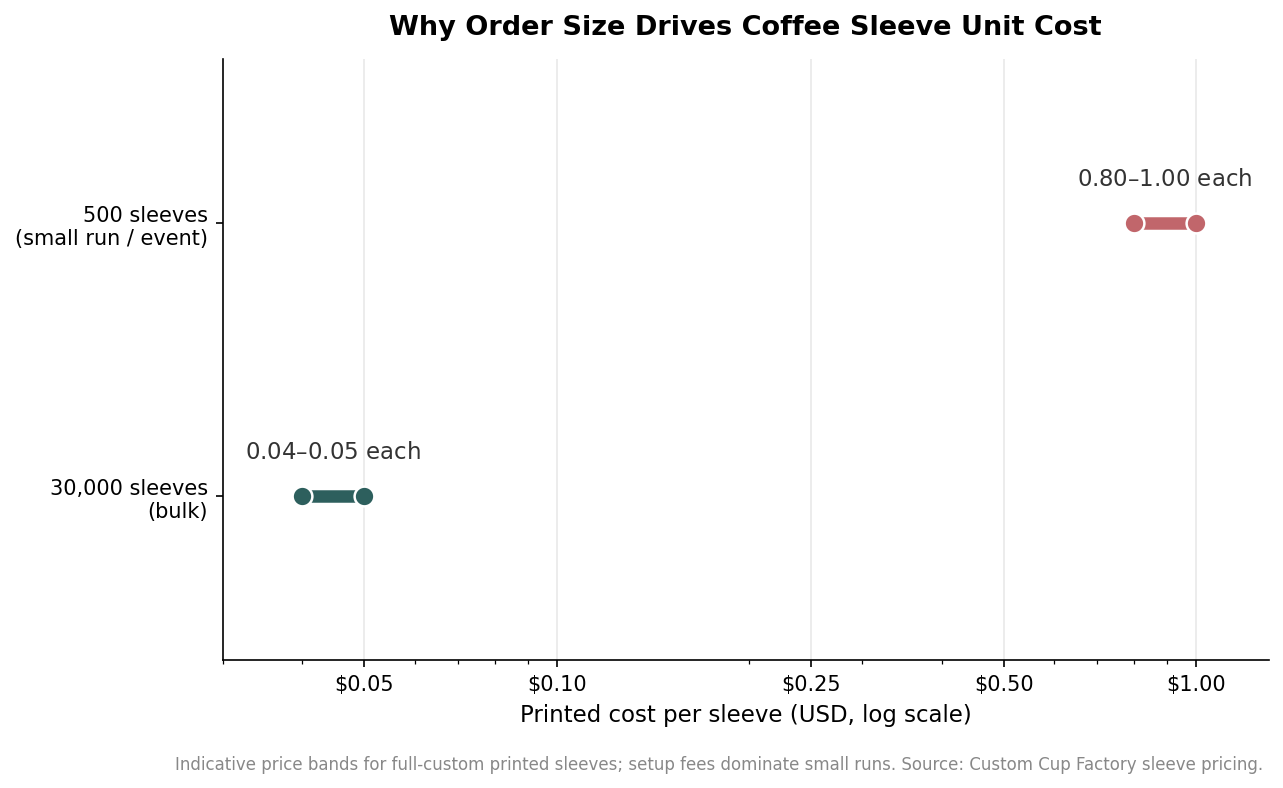
Lead time follows the same logic. A full-custom bulk order commonly runs on the order of eight to twelve weeks from artwork approval to delivery, so a large economical run is something to plan seasons ahead, not something to order the week before a launch. If you need sleeves fast or in small numbers, a digital short run costs more per piece but buys you speed and flexibility.
Choosing for your situation
Put the three decisions in order and the choice makes itself. If you are a small cafe, a pop-up, or running an event, a digital run of 500 to 1,000 on the substrate that suits your art is the sane starting point, and if your look leans minimal, kraft with one ink keeps it cheap and handsome. If you are an established shop going through sleeves by the case every week, planning a large flexo or offset run in one or two spot colors is where the per-piece cost becomes almost negligible, provided you can commit to the volume and the lead time. Above all, decide your substrate and color count before you fall in love with a design, because the board and the ink are what your customers actually hold, and they are the constraints every other choice has to respect.
Leave a Reply