The eco-friendly language on a coffee sleeve is where a lot of good intentions quietly turn into indefensible claims. A cafe orders a natural-looking kraft sleeve, sees the words recycled and compostable on the supplier’s page, and prints “100% compostable” across the band, without noticing that the claim only holds under conditions the cafe does not control. Recycled, recyclable, and compostable are three different promises about three different moments in a sleeve’s life, and getting them straight is the difference between an honest sustainability story and a greenwashing complaint.
“Recycled” describes what went in, not what happens next
A recycled claim is about the fiber the sleeve was made from, and the important distinction hides inside the word. Post-consumer recycled content is material that already did a life as a product and was diverted from a landfill, while pre-consumer content is factory offcuts that never reached a consumer. Only the post-consumer portion actually pulls waste back out of circulation, so a sleeve advertised as “100% recycled” with 90%-plus post-consumer fiber is doing far more environmental work than one that reaches its recycled percentage mostly through mill scrap.
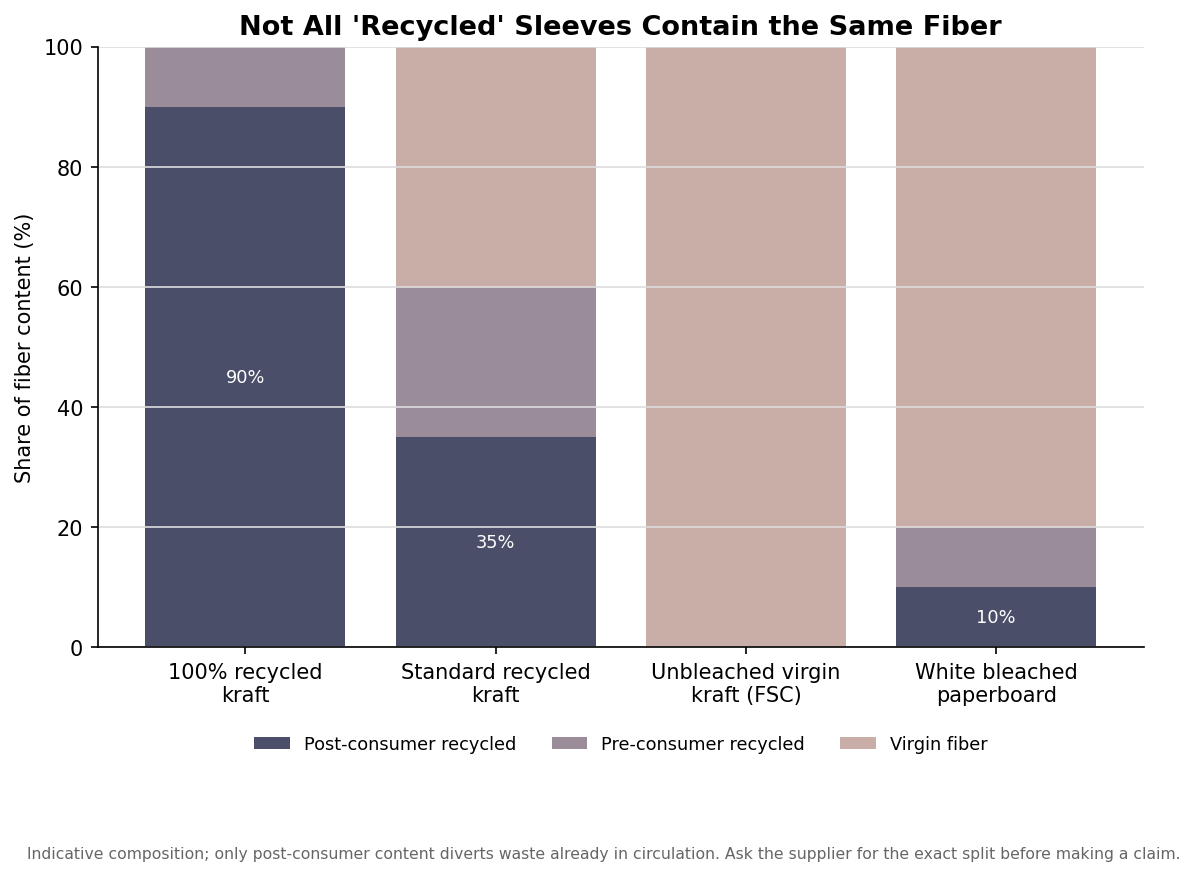
The practical move is to ask the supplier for the exact split before you print a number on the band. “Made with recycled material” is safe and vague; a specific “90% post-consumer recycled” is powerful but only if the certificate backs it. If you cannot get the breakdown in writing, keep the claim general rather than inventing a figure.
“Recyclable” depends on the whole sleeve, not just the paper
Kraft and corrugated paperboard are recyclable in principle, but recyclability is a property of the finished sleeve, not the raw stock. What tends to disqualify a sleeve is everything added after the fiber: heavy ink coverage, plastic lamination, foil, or a moisture coating can all push a sleeve out of the paper stream at a materials recovery facility. Because a sleeve barely touches the drink, it usually stays clean enough to recycle, which is an advantage over food-soiled packaging, but that advantage evaporates if the decoration is not paper-compatible.
To keep a recyclable claim honest, favor uncoated stock and water-based or soy-based inks, and be cautious with full-bleed dark backgrounds that pile on ink. The plainer the construction, the more confidently you can say the sleeve belongs in the recycling bin, and the less you are relying on a hopeful consumer to guess.
“Compostable” almost always means industrial, unless proven otherwise
Compostable is the claim that gets cafes into the most trouble, because the unqualified word implies something most sleeves cannot deliver. A defensible compostable claim rests on certification to a standard such as ASTM D6400, typically verified through a program like BPI, and that certification is for industrial composting, where sustained high heat breaks the material down. Home compost piles rarely reach those conditions, so “home compostable” is a separate, higher bar that most paper sleeves do not clear.
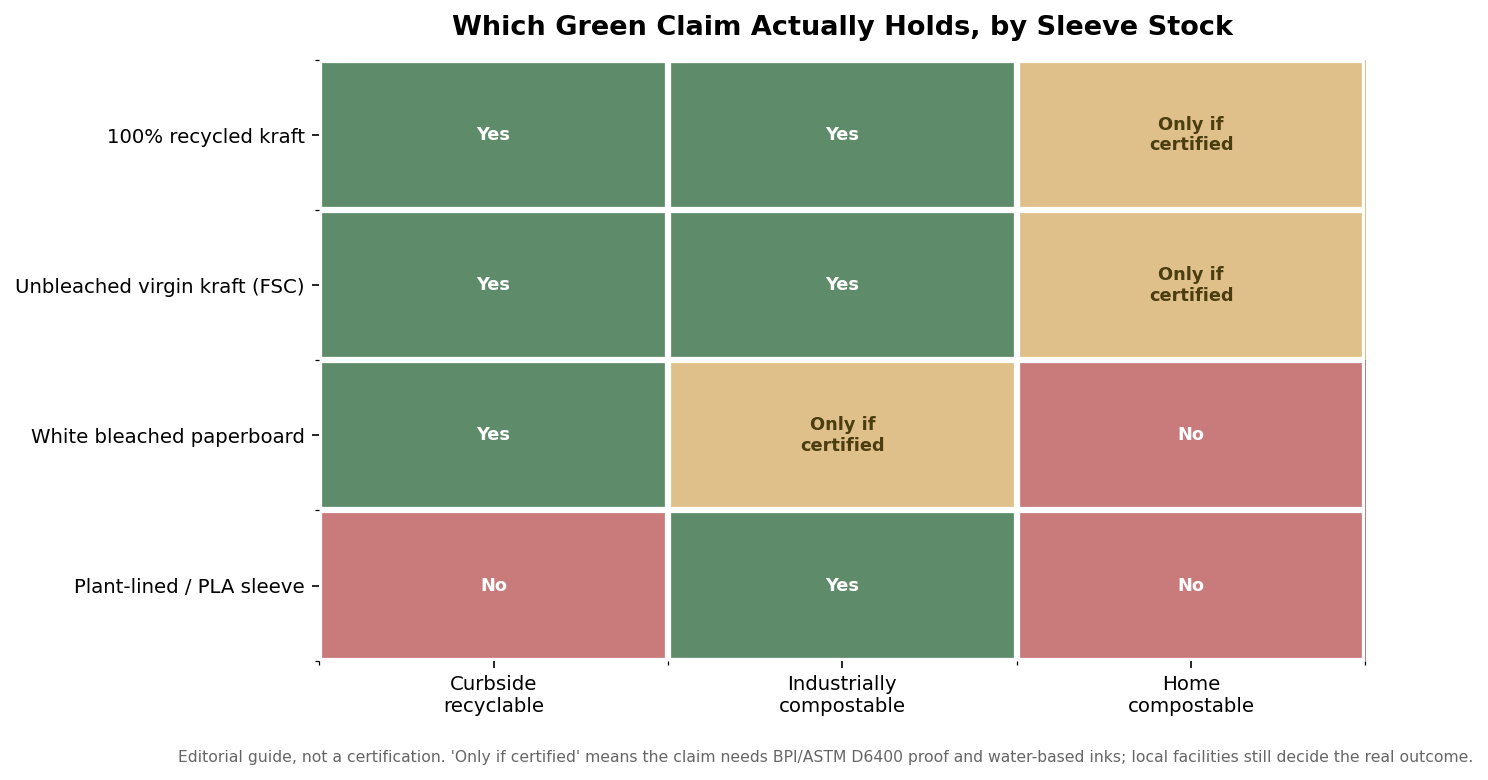
Two things quietly control whether the claim survives contact with reality. The first is ink: a sleeve is only compostable when it is printed with compostable, usually water-based, inks, so a solvent-heavy print can void the certificate you paid for. The second is access, because a sleeve that is technically industrially compostable still ends up in a landfill if the customer has no commercial composting collection. Honest labeling acknowledges that gap rather than implying the sleeve disappears on its own. The safe wording qualifies the claim, as in “industrially compostable where facilities exist,” rather than a bare “compostable.”
FSC is about where the fiber came from
Forest Stewardship Council certification answers a different question again: not what happens to the sleeve, but whether its virgin fiber was responsibly sourced. An FSC chain-of-custody claim traces the paper back through the supply chain to well-managed forests, which is why FSC and recycled content are complementary rather than interchangeable. A sleeve can be FSC-certified virgin kraft, high in recycled content, or a mix, and each tells a distinct story. Using the FSC logo also requires a valid license tied to the certified supplier, so you cannot simply add the mark because your stock happens to be FSC somewhere upstream.
For a buyer, the useful takeaway is to pick the origin story that matches the product and say only that. If the sleeve is recycled kraft, lead with the recycled content. If it is responsibly sourced virgin fiber, lead with FSC. Stacking every green word onto one band dilutes the credible claims and invites scrutiny of the weak ones.
Making a claim you can actually stand behind
The connecting thread is that each green word maps to a specific piece of evidence, and your printed claim should never outrun that evidence. Recycled maps to a content breakdown, recyclable maps to paper-compatible construction and inks, compostable maps to an ASTM D6400 or BPI certificate plus compostable inks, and FSC maps to a licensed chain-of-custody claim. In the spirit of the FTC’s guidance on environmental marketing, a claim should be specific, qualified where necessary, and substantiated by documentation you could produce if asked.
Specify the sleeve, then, by starting from the claim you want to make and working backward to the stock, the ink, and the certificate that would make it true. Ask for the post-consumer percentage in writing, confirm the ink is compatible with your recyclable or compostable story, qualify a compostable claim to industrial facilities, and use the FSC mark only under a valid license. Do that, and the sustainability line on your sleeve becomes an asset you can defend rather than a liability waiting for a sharp-eyed customer, because every word on the band is backed by a document in your file.
Leave a Reply