Category: Buying Guides

  • Custom Coffee Sleeves: 2026 Pricing, MOQs & Lead Times

    If you’re pricing out custom coffee sleeves for a cafe, roastery, or event, the numbers that actually matter before you commit are cost per unit, minimum order quantity, and how long the print run takes to land on your shelf. Those three figures vary more between suppliers than most first-time buyers expect, and getting them wrong means either overpaying for a tiny batch or sitting on 10,000 sleeves you didn’t need. This guide walks through what custom coffee sleeves actually cost at different order sizes, how MOQs are structured across the market, realistic lead times, and the material tradeoffs between kraft, corrugated, and coated stock.

    None of the figures below are estimates pulled from thin air — they’re drawn from published pricing pages and production-time disclosures from active sleeve suppliers, checked this month. Where a supplier didn’t publish hard numbers, we’ve said so rather than guessing.

    $0.20-$0.95
    Per-sleeve price range, 100 to 10,000 units
    50-60,000+
    MOQ range across digital vs. offset suppliers
    7 days-8 weeks
    Lead time range, small digital run vs. bulk offset

    Source: Keg Collars Network pricing page; Teal Packaging, HotShot Sleeves, Java Jacket, Good Start Packaging lead-time pages, accessed August 2026

    What custom coffee sleeves cost at every order size

    Per-unit pricing on custom coffee sleeves drops fast as volume climbs, which is the single biggest reason small orders feel disproportionately expensive. A batch of 100 sleeves can run close to a dollar each, while the same design at 10,000 units lands closer to 20 cents. That’s not a supplier padding small orders — plate setup, press changeover, and short-run material waste are largely fixed costs that get spread thinner as quantity increases.

    The chart below shows actual published tier pricing for custom-printed kraft coffee sleeves. Use it as a sanity check against any quote you receive: if a supplier’s small-quantity price is dramatically higher than these tiers, ask what’s driving it — often it’s a rush fee, a premium finish, or a plate charge that should be a one-time cost, not baked into every unit.

    Per-sleeve price falls from $0.95 at 100 units to $0.20 at 10,000 units100: $0.95; 250: $0.85; 500: $0.55; 1,000: $0.45; 2,000: $0.29; 4,000: $0.25; 6,000: $0.22; 8,000: $0.21; 10,000: $0.20100$0.95250$0.85500$0.551,000$0.452,000$0.294,000$0.256,000$0.228,000$0.2110,000$0.20
    Per-sleeve price falls from $0.95 at 100 units to $0.20 at 10,000 unitsSource: Keg Collars Network, custom coffee sleeve quantity pricing page, accessed August 2026

    How minimum order quantities actually work

    There’s no single industry-standard MOQ for custom coffee sleeves — it depends heavily on printing method and who’s running the press. Digital-print suppliers built for smaller cafes and one-off events often start at 50 to 250 units, which suits a pop-up or a single-location shop that wants branded sleeves without committing to a warehouse’s worth of inventory. Some print shops will go as low as 100 pieces on a basic one-color kraft sleeve.

    At the other end, large-format offset suppliers who serve chains and distributors quote in cases rather than pieces — minimums of 40 to 60 cases are common, which can translate to 50,000 sleeves or more before the per-unit price gets genuinely competitive. If you’re a single independent cafe, that tier isn’t for you; it’s built for roasters supplying dozens of wholesale accounts. Match your supplier to your actual order size rather than chasing the lowest headline price per unit, since a 60-case minimum is a wasted quote if you only need 2,000 sleeves for a seasonal launch.

    A practical middle ground for most independent shops ordering custom coffee sleeves for the first time is 500 to 2,000 units — enough to get meaningfully below the small-batch price without tying up cash in stock you won’t use in six months.

    Reordering vs. first-time orders

    Your first order should lean smaller than you think you need, even at a worse per-unit rate. Sleeve design, cup size, and branding decisions shift after you’ve actually handed a printed sleeve to customers for a few weeks. Reorders can scale up once you know the design is final and you have real usage data on how fast you go through a case.

    Lead times: how long custom coffee sleeves take to print

    Turnaround for custom coffee sleeves ranges from about a week to two months, and the gap is almost entirely about press type and order size, not shipping. Digital and small-format printers running short runs for independent cafes typically quote 7 to 10 business days from proof approval, with rush service available at some shops for an added fee. Larger offset runs — the kind tied to those 40-plus case minimums — quote 2 to 8 weeks, since they’re batching multiple customers’ jobs onto shared press runs and waiting on paper stock.

    Before you count on a delivery date, get the proof-approval clock in writing separately from the print-production clock. Most suppliers won’t start the production countdown until you’ve approved a digital proof, and that proofing step alone commonly adds 1 to 3 business days on its own.

    Standard production time for custom coffee sleeves ranges from 7 business days to 8 weeks depending on print method and order size
    Supplier Standard Lead Time
    Teal Packaging 7 business days
    HotShot Sleeves 7-10 business days (rush available)
    Your Brand Cafe (dimpled sleeves) 3 weeks
    Java Jacket (bulk/wholesale) 2-8 weeks
    Good Start Packaging 6-8 weeks from approved artwork
    Standard production time for custom coffee sleeves ranges from 7 business days to 8 weeks depending on print method and order sizeSource: Published production/lead-time pages: Teal Packaging, HotShot Sleeves, Your Brand Cafe, Java Jacket, and Good Start Packaging, accessed August 2026

    Kraft, Corrugated, or coated: picking the right material

    Most custom coffee sleeves fall into three material categories, and the choice affects both feel and cost. Flat kraft paperboard is the cheapest and most common option — it’s a single-ply, uncoated sheet that prints well in one or two colors and is fully recyclable, but it offers the least insulation, so it’s best suited to smaller cups or shorter hold times.

    Corrugated kraft sleeves add a fluted inner layer sandwiched between two liners, the same basic construction as shipping cardboard. That flute traps air and noticeably improves heat insulation, which is why most cafes serving 12-ounce-and-up hot drinks default to corrugated rather than flat stock. It also has more surface texture, which can make fine print detail or small text harder to read cleanly than on smooth kraft.

    Coated white or gloss paperboard is the premium tier — it takes full-color CMYK printing with sharper detail and richer color saturation than either kraft option, plus finishes like matte or soft-touch lamination and spot UV. It costs more per unit and isn’t compostable the way plain kraft is, so it’s a better fit for brands prioritizing shelf appeal or retail resale over sustainability messaging.

    Post-Consumer Content

    If sustainability claims matter to your customers, ask suppliers directly about recycled content percentage rather than assuming “kraft” means recycled — some kraft stock is virgin fiber. Corrugated kraft sleeves with meaningful post-consumer recycled content are widely available and worth specifying by name in your order, since it’s not automatic across every supplier’s default stock.

    Printing methods and Sizing your sleeve

    Two printing approaches dominate the custom coffee sleeve market: flexographic printing, used for large offset runs, and digital printing, used for smaller batches. Flexo gets cheaper per unit at high volume but requires a physical printing plate, which is where those 40-case minimums come from — the plate cost only pencils out once it’s spread across tens of thousands of units. Digital printing skips the plate entirely, which is why small-batch suppliers can offer MOQs in the low hundreds, though the per-unit cost stays higher since there’s no plate-amortization discount to chase.

    Sizing is the other detail buyers underestimate. Sleeves aren’t universal — a sleeve cut for a 12-ounce cup will sit loosely or bunch on an 8-ounce cup, and won’t stretch far enough on a 20-ounce cup to stay put. Confirm your cup’s exact diameter and height with your supplier before finalizing artwork, since a print run sized for the wrong cup can’t be resized after the fact without reprinting the whole order.

    Frequently asked questions

    What’s the minimum order for custom coffee sleeves?

    It depends on the printer. Digital-print suppliers serving independent cafes commonly start at 50 to 250 units, while large offset/flexo suppliers require case minimums that often total 40,000-60,000+ sleeves. Check which type of press a supplier uses before assuming their quoted MOQ applies to your order size.

    How much do custom coffee sleeves cost per unit?

    Published tier pricing runs from about $0.95 per sleeve at 100 units down to roughly $0.20 per sleeve at 10,000 units, with the steepest price drops happening between 250 and 2,000 units.

    How long does it take to get custom coffee sleeves printed?

    Small digital runs typically ship in 7 to 10 business days after you approve a proof. Larger offset orders tied to case minimums usually take 2 to 8 weeks, since they’re batched onto shared press schedules.

    Is kraft or corrugated better for custom coffee sleeves?

    Corrugated kraft insulates significantly better because of its fluted inner layer, making it the better choice for 12-ounce-and-up hot drinks. Flat kraft is cheaper and prints cleaner detail but offers less heat protection, so it suits smaller cups or cold drinks better.

    Can I order a small batch of custom coffee sleeves for a one-time event?

    Yes. Digital-print suppliers with 50-250 unit minimums are built for exactly this — a one-time event, a pop-up, or a seasonal design test — though the per-unit price will be closer to the high end of the pricing range shown above.

    The bottom line

    The fastest way to get a fair quote on custom coffee sleeves is to know your realistic order size before you ask for pricing. If you’re testing a design or serving a single location, look at digital suppliers with 50-250 unit minimums and 7-10 day turnaround, and expect to pay closer to $0.50-$0.95 per sleeve at that scale. If you’re stocking a multi-location chain or wholesale accounts, offset suppliers with case minimums will get you well under $0.25 per unit — but budget 2 to 8 weeks and don’t order until your artwork and cup sizing are locked, since that volume doesn’t leave room for a quick reprint.
  • Custom Coffee Sleeves: Materials, Sizing & Branding Guide

    Custom Coffee Sleeves: Materials, Sizing & Branding Guide

    Custom Coffee Sleeves: A Materials, Sizing, and Branding Guide

    Getting custom coffee sleeves right comes down to three decisions: the material, the size or spec, and how you brand them. Make those well and you end up with custom coffee sleeves that protect and present your product, reinforce your brand, and land on budget. This guide walks through the material options, how to size and spec your order, and how to decorate custom coffee sleeves so they do real work for your brand rather than just checking a box.

    Whether you are ordering your first run or reordering at scale, the same fundamentals apply. Choosing custom coffee sleeves deliberately — material to job, size to product, decoration to brand — is what separates an order you are proud of from one you settle for.

    Why custom coffee sleeves matter for your brand

    Custom coffee sleeves are more than a commodity; they are a touchpoint brands experience directly. A well-chosen, well-branded option signals quality and attention to detail, while a generic one quietly undercuts an otherwise strong product. Because custom coffee sleeves are seen and handled, they carry your brand into the world every time they are used.

    That visibility is exactly why it pays to spec custom coffee sleeves intentionally. The material sets the feel, the size sets the fit and cost, and the decoration sets the impression — and getting all three aligned turns a functional item into a genuine brand asset.

    Materials and options compared

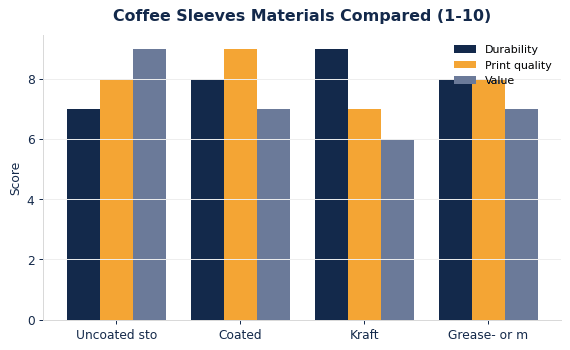
    The common materials for custom coffee sleeves each trade off durability, print quality, and cost: uncoated stock, coated / gloss stock, kraft / recycled, and grease- or moisture-resistant. The right pick depends on how the coffee sleeves will be used, the look you want, and your budget. The chart and table below compare the main options so you can match material to job.

    How common coffee sleeves materials compare on durability, print quality, and value.
    How common coffee sleeves materials compare on durability, print quality, and value.

    As a rule of thumb, choose a recyclable or natural material when eco positioning matters, a coated or laminated option when you want vivid full-color print, and a premium build when the coffee sleeves is part of a gift or high-end presentation. When in doubt, request a sample so you can judge feel and print before committing to a full run.

    Material / optionBest for
    Uncoated stocknatural, writable surface with a matte look
    Coated / gloss stockvivid color and a polished finish
    Kraft / recycledeco-forward, warm natural tone
    Grease- or moisture-resistantfood-safe performance where needed

    Sizing and specs

    Sizing is where many coffee sleeves orders go wrong, so measure before you order. Custom coffee sleeves typically range from a small insert card up to a full wrap or liner sheet, and the right size and weight depends on the product or use they serve. Too small and the fit is tight or the product is exposed; too large and you pay for material you do not need and lose a clean, intentional look.

    When a measurement falls between standard options, size to the product with a small margin rather than guessing. Confirming the size and weight on a proof or sample before a large run prevents the costly mistake of a full order that does not fit, which is far more expensive to fix than a five-minute check up front.

    Branding and decoration

    Decoration is what turns a plain coffee sleeves into a branded one. Digital and offset printing reproduce full-color art crisply, with spot colors and foil available for a premium touch. Match the method to your artwork and budget: simple logos reproduce cleanly and cheaply, while detailed, full-color designs shine with the right process on the right material. Keep the artwork vector where possible and confirm the print area for your chosen size.

    Restraint usually reads as premium. A clean logo, one or two brand colors, and quality material almost always look more considered than a busy, over-printed design. Approving a proof before the run protects both the look and the budget, especially on a large order of custom coffee sleeves.

    Ordering and budget

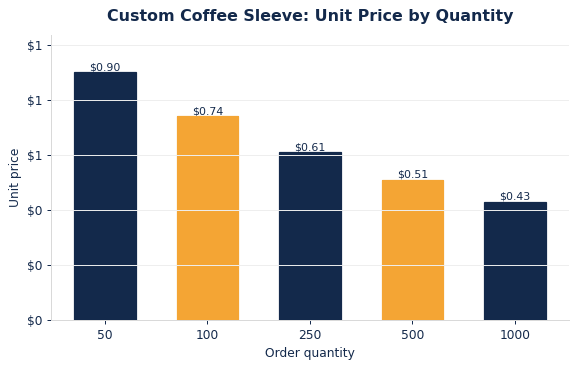
    Per-unit cost on custom coffee sleeves falls steadily with volume as setup amortizes across more pieces, so ordering for real demand rather than a token first batch is usually the efficient move. The curve below shows how pricing typically improves with quantity, which helps you plan an order that balances cash and cost.

    Typical per-unit coffee sleeves pricing as order quantity increases.
    Typical per-unit coffee sleeves pricing as order quantity increases.
    Ordering for a recurring need? A single larger run lowers the unit cost and keeps your branding consistent, while a small overage covers reorders and the occasional damaged piece without a rush order.

    Common mistakes to avoid

    A few avoidable missteps account for most disappointing coffee sleeves orders. Ordering before measuring is the biggest, followed by choosing a material for price alone without considering how the coffee sleeves will actually be used, and skipping the proof on a large run. Each is easy to prevent with a few minutes of planning, and each is expensive to fix once a full order is produced.

    The other common trap is over-designing the artwork. Cramming in too many colors, effects, or details can muddy the print and raise the cost, especially on textured or recycled materials. Simplifying the design to a clean, legible mark almost always improves both the look and the price of your custom coffee sleeves.

    Frequently asked questions about custom coffee sleeves

    What material is best for custom coffee sleeves?

    It depends on the use: choose a recyclable or natural material for eco positioning, a coated or laminated option for vivid full-color print, and a premium build for gifting or high-end presentation. Request a sample to judge feel and print before a full run of custom coffee sleeves.

    How do I choose the right size?

    Measure the product or use the coffee sleeves serves, then size to it with a small margin so the fit is clean without wasting material. When a measurement falls between standard options, size up slightly and confirm the size and weight on a proof before ordering in volume.

    How are custom coffee sleeves branded?

    Digital and offset printing reproduce full-color art crisply, with spot colors and foil available for a premium touch. Match the method to your artwork and budget, keep the art vector where possible, confirm the print area for your size, and approve a proof so the finished custom coffee sleeves match your intent.

    How does pricing work, and is there a minimum?

    Per-unit cost drops with quantity as setup amortizes across the run, so larger orders are more cost-effective. Order for real demand plus a small overage rather than a token batch, and consolidate recurring needs into one run for the best price.

    Can I get a sample or proof before ordering?

    Yes, and it is strongly recommended. A physical sample lets you judge material and print, and a digital or physical proof confirms your artwork, color, and size and weight before a full run — a small step that prevents a costly mistake on a large order.

    What do you need to quote custom coffee sleeves?

    To quote accurately we need the size and weight or the product they serve, the quantity, your material preference, and your artwork or a description of the branding. With those details we can recommend the right material and size and give you pricing for the run, and a proof follows once the order is confirmed.

    Whatever you order, send vector artwork, confirm material and size and weight, and approve a proof before production. For help matching custom coffee sleeves to a specific use, see our companion guide, our How to Choose Custom Coffee Sleeves for Your Brand, and explore our our shop to start your order.

    Ready to order custom coffee sleeves?

    Tell us your product, quantity, and branding and we’ll match the material, size, and decoration for you.

    Get a Quote